
What Is a Turkish Towel? A Guide to the Peshtemal
Ask for a Turkish towel in the United States and you may be handed one of two very different things: a thick, looped bath towel made from Turkish cotton, or a thin, flat-woven cloth with a striped body and fringed ends. The second is the original. It is called a peshtemal, and it is one of the most useful textiles a home can own.
This guide explains what a Turkish towel is, why it dries so much faster than terry, how to tell a well-made one from a printed imitation, and the many places it earns its keep.
In this guide
The Short Answer
A Turkish towel, or peshtemal, is a large towel woven flat from cotton or a cotton-linen blend, rather than looped into a pile like terry. It comes from the Turkish hammam, where it was wrapped around the body long before looped terry towels became common.
Because the cloth is thin, it absorbs on contact and releases moisture back into the air quickly. It dries in a fraction of the time a terry towel needs, folds small, sheds sand and grows softer with washing.
You will see the word spelled several ways: peştemal in Turkish, and peshtemal or pestemal in English. Hammam towel and Turkish bath towel describe the same cloth.
Turkish Towel vs. Turkish Cotton Towel
The two names overlap, which causes most of the confusion.
- A Turkish cotton towel describes the fiber. It is usually a terry towel, with thousands of small loops, woven from cotton grown in Türkiye. Our plush, waffle and Fine Weave towels are Turkish cotton towels.
- A Turkish towel describes the construction. It is a flat-woven peshtemal, usually with woven stripes and hand-knotted fringe, made from cotton, linen or both.
Both can be excellent. They simply do different jobs. For more on the fiber itself, our guide to what Turkish cotton is covers it in depth.
How a Flat Weave Dries You
A terry towel dries you with volume. Its loops form a deep pile that soaks up water and holds it, which is why a plush towel feels so substantial, and why it can still be damp on the rail hours later.
A flat weave works differently. The cloth is thin enough that water passes into it and straight back out into the air, so it absorbs quickly and releases quickly. You wipe rather than pat, and one pass is usually enough. A few hours after use, a peshtemal feels almost dry in the hand.
There is a bonus. With no pile to crush, the cloth softens rather than flattens over time, and most flat-woven towels become noticeably more absorbent over their first few washes as the yarns relax.

Turkish Towel vs. Terry Towel at a Glance
| Turkish towel (peshtemal) | Terry towel | |
|---|---|---|
| Construction | Woven flat, like fabric | Looped pile |
| In the hand | Light and thin | Heavier, especially plush |
| Drying time | Fast, often an hour or two | Slower, especially in a humid bathroom |
| How it absorbs | Wipes dry on contact | Soaks water into the pile |
| Storage and travel | Folds small, packs flat | Bulky |
| At the beach | Shakes sand loose | Holds sand in the loops |
| Feel | Smooth, soft, softer with age | Plush and cushioned |
| Best for | Travel, beach, small or humid bathrooms | Long baths, a cocooning wrap |
Is a Turkish Towel Right for You?
A peshtemal is the better choice if you:
- want a towel that is dry again by your next shower,
- live somewhere humid or have a small bathroom with little airflow,
- travel, swim or go to the beach often, or
- prefer a lighter towel that takes up little room on the shelf.
It is not the towel for someone who wants to be enveloped in thick pile after a long bath. For that, a plush terry such as Montecito or Maris is the answer. Many homes keep both: plush for the main bath, flat-woven for everything else.
Ways to Use a Turkish Towel
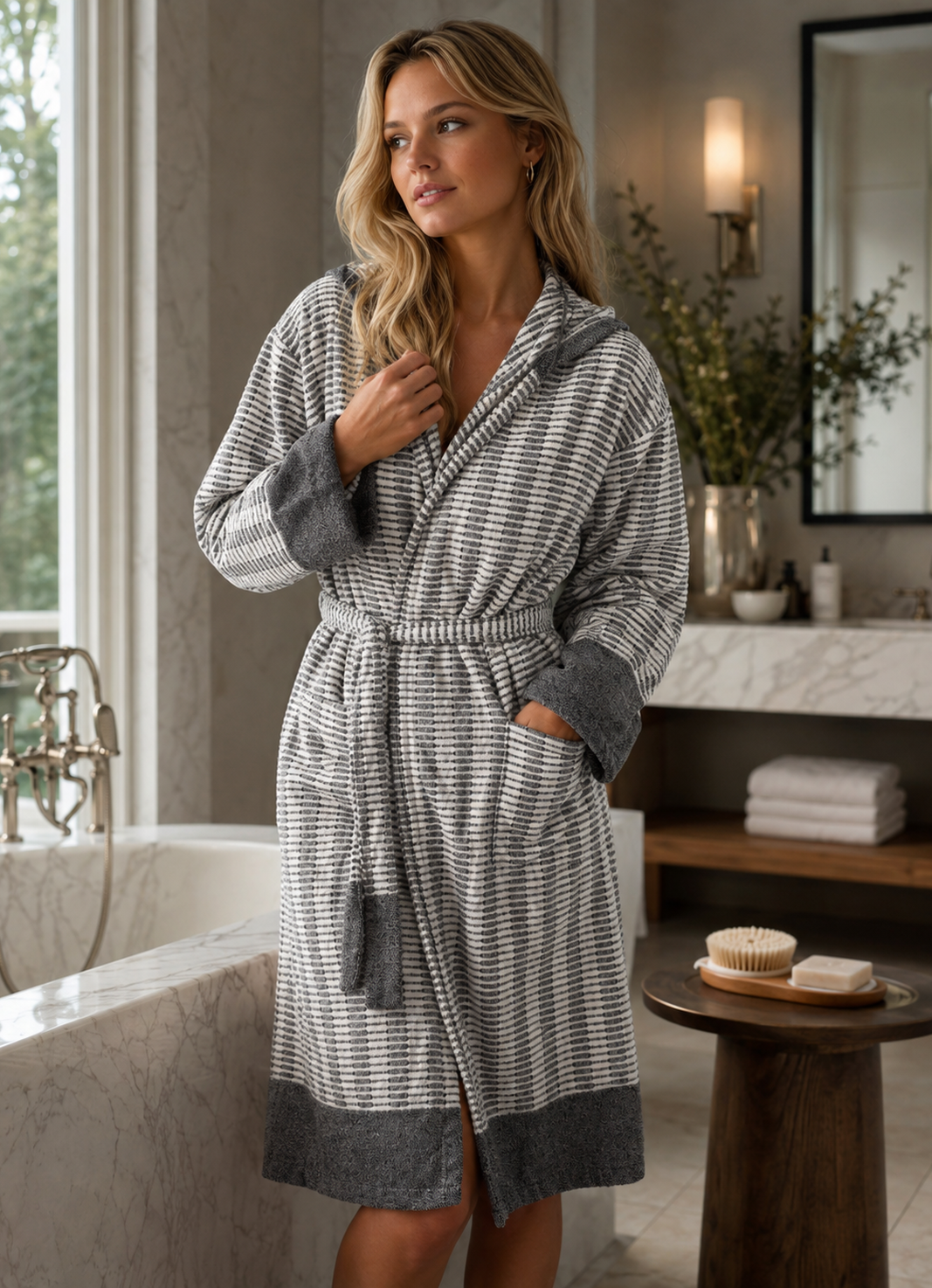
- After a bath or shower. Cut to bath sheet size, a peshtemal wraps fully around the body.
- At the beach or pool. It covers a lounger, shakes sand loose and dries in the sun.
- For travel. It packs into a fraction of the space of a terry bath sheet and doubles as a wrap on a cool evening.
- At the gym or spa. Light to carry, and quick to dry in a bag.
- As a throw. Over a bench, a chair or the end of a bed, it adds texture without bulk.
- For guests. A rolled stack in a basket is a simple way to welcome summer visitors.

How to Tell a Well-Made Turkish Towel
Turkish towels are now sold almost everywhere, and many are printed imitations of a woven original. Five details separate the two.
1. The pattern is woven, not printed
Turn the towel over. On a yarn-dyed peshtemal the stripes appear on both sides, because the colored yarns run through the cloth. Printed stripes sit on the surface and fade with washing.
2. The fiber is named
Look for 100% cotton, ideally long-staple Turkish cotton, or a cotton-linen blend. Linen adds structure and dries faster; cotton adds softness.
3. The weight suits the use
Lighter towels, around 200 to 250 g, are ideal for packing and the beach. Heavier flat weaves and muslins, around 300 to 450 g, feel more like a proper bath sheet at home.
4. The fringe is part of the cloth
On a well-made towel the fringe is twisted and hand-knotted from the warp threads themselves, not sewn on afterward.
5. It is certified
OEKO-TEX Standard 100 certification means the finished textile has been tested for a broad range of harmful substances, which matters for something you wrap around your skin.

Calinea's Turkish Towels
Our flat-woven and muslin bath sheets are woven in Türkiye and sized to work as both a bath sheet and a beach towel. Each has its own character.
| Towel | Fiber and weave | Size | Weight | Price |
|---|---|---|---|---|
| Aveline | 100% Aegean cotton, flat weave with a herringbone band | 36 × 63 in | 220 g | $44 |
| Linea | 100% long-staple Turkish cotton, textured flat weave | 35 × 67 in | 330 g | $48 |
| Tessera | 100% Turkish cotton, flat weave with a woven mosaic band | 35 × 67 in | 372 g | $48 |
| Altea | 100% Turkish cotton crinkle muslin | 36 × 67 in | 295 g | $55 |
| Airy Aegean | 100% long-staple Turkish cotton muslin | 38 × 66 in | 432 g | $58 |
Altea and Airy Aegean are woven as muslin, an open gauze, rather than a classic flat weave. They behave in much the same way: light, quick to dry and soft, with a gentle crinkle that deepens with every wash. For a linen-rich version, the Turkish Linen Bath Sheet blends 70% linen with 30% cotton for extra structure. Our guide to bath sheets vs. bath towels explains the sizes.
How to Care for a Turkish Towel
- Wash before first use; absorbency improves over the first few washes.
- Machine wash cold or warm with like colors, using a mild detergent.
- Skip fabric softener and bleach. Softener coats the fibers and reduces absorbency.
- Tumble dry low or line dry.
- Shake the fringe out while damp. Trim a stray thread with scissors; never pull it, as the fringe is twisted from the warp.
- After the beach, rinse out salt and sand before the next wash.
Our towel care guide covers washing in more detail.
Frequently Asked Questions
What is a Turkish towel?
A Turkish towel, or peshtemal, is a large flat-woven towel of cotton or a cotton-linen blend, traditionally used in the Turkish hammam. It is thinner and lighter than a terry towel, dries much faster and is usually finished with hand-knotted fringe.
Are Turkish towels absorbent?
Yes. They absorb differently from terry: water passes into the thin cloth on contact and then evaporates quickly, so you wipe rather than pat. Absorbency improves noticeably over the first few washes.
Why are Turkish towels so thin?
Because they are woven flat rather than looped into a pile. The thinness is what makes them dry quickly, pack small and shed sand.
Can a Turkish towel be your everyday bath towel?
Yes, especially when it is sized as a bath sheet. Many people prefer one in humid climates or small bathrooms, where a terry towel never fully dries between uses.
Are Turkish towels good beach towels?
They are among the best. They cover a lounger, dry in the sun, shake sand loose and fold small enough for a tote.
How do you make a Turkish towel softer?
Wash it. Flat-woven cotton softens and becomes more absorbent with each of the first several washes. Avoid fabric softener, which coats the fibers.
What is the difference between a peshtemal and a hammam towel?
There is none. Peshtemal is the Turkish name; hammam towel and Turkish towel are English names for the same flat-woven cloth.
The Bottom Line
A Turkish towel is the original towel of the hammam: flat-woven, light, fast-drying and endlessly useful. Choose one with a woven pattern, a named fiber and fringe twisted from the cloth, and it will grow softer for years, in the bathroom, at the beach and everywhere in between.
Shop Turkish towels · Bath sheets · Beach towels
Refined living, naturally.